From The Galaxy of Strats Book
By Yasuhiko Iwanade (Publisher Rittor Music)
The Galaxy of Strats book was written in Japanese in Japan in 1998. The below translation has been made by Yasuhiko Iwanade.
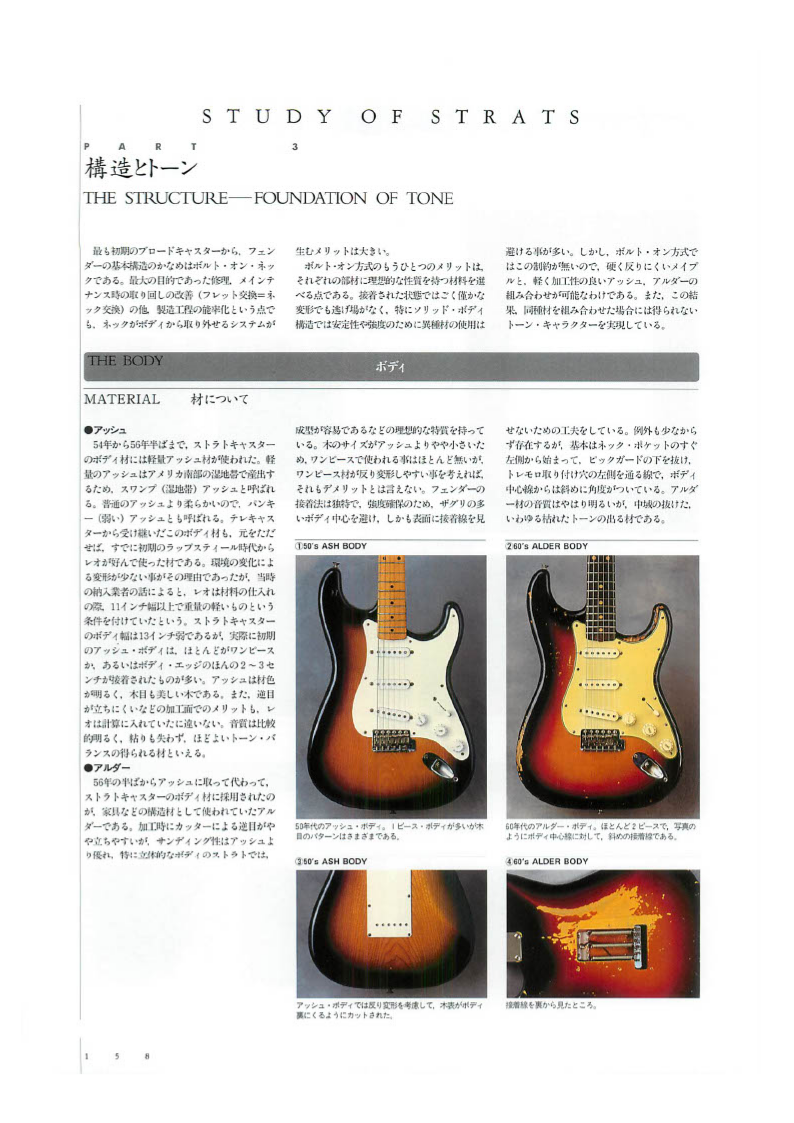
STUDY OF STRATS PART 3
THE STRUCTURE —– FOUNDATION OF TONE
From the very earliest Broadcasters onward, the bolt-on neck has been a cornerstone of Fender’s basic construction. Its primary purpose was to simplify repair and maintenance—re-fretting, for example, could effectively be handled by replacing the neck—but the ability to remove the neck from the body also offered major advantages in terms of manufacturing efficiency.
Another advantage of the bolt-on system is that materials with the ideal characteristics can be selected independently for each component. When different woods are permanently glued together, even slight dimensional changes have nowhere to go, causing distortion or crack at the joint, particularly in solid-body construction. Thus, the use of dissimilar woods is often avoided for reasons of stability and structural strength. The bolt-on system is free from this constraint, making it possible to combine dense, warp-resistant maple with lightweight, easily worked ash or alder. This combination also produces tonal characteristics that cannot be obtained when the same type of wood is used throughout.
THE BODY
MATERIAL
ASH
From 1954 through the middle of 1956, lightweight ash was used for Stratocaster bodies. Because this lightweight ash grows in the swampy regions of the southern United States, it is commonly known as “swamp ash.” Being softer than ordinary ash, it has also been referred to as “punky” ash—meaning that it would be considered relatively weak for applications such as baseball bats or furniture.
Although Fender inherited this body wood from the Telecaster, its origins in Leo Fender’s instruments go back even further to his early lap-steel guitars. Leo favored ash because of its dimensional stability under changing environmental conditions.
Regarding requirements for procurement, according to one of Fender’s suppliers at the time, Leo specified ash stock that was at least 11 inches wide and light in weight. The Stratocaster body is just under 13 inches wide, and in fact, most early ash bodies were either one-piece bodies or had only a narrow strip of less than few inches wide glued along one edge on lower bout, where it was hidden under dark rim color of sunburst finish.
Ash is light in color and has an attractive grain pattern. Leo must also have taken into account its advantages in machining, including its relatively low tendency to tear out when cutting against the grain. Tonally, ash is comparatively bright while retaining a certain resilience and body, giving it a well-balanced tonal character.
ALDER
Around the middle of 1956, Alder replaced ash as the principal body wood for the Stratocaster. Alder had long been used as a structural wood in furniture and similar applications. Although it is somewhat more prone than Ash to grain tear-out during machining, because of its subdued grain and pore structure, it sands more easily and possesses characteristics particularly well suited to the Stratocaster, whose body requires extensive three-dimensional shaping.
Because Alder trees generally yield somewhat smaller boards than ash, one-piece alder bodies are rare. Considering that a one-piece body is inherently more susceptible to warping and dimensional change, however, this cannot necessarily be regarded as a disadvantage.
Fender employed a distinctive method of joining the body blanks. To maintain strength, the glue joint was kept away from the heavily routed center area of the body, while at the same time care was taken to keep the joint line from being visible on the front surface.
Although there are numerous exceptions, the typical joint begins just to the left of the neck pocket, runs beneath the pickguard, and passes to the left of the tremolo mounting holes. As a result, the glue line runs at an angle rather than parallel to the body centerline.
Alder is also a relatively bright-sounding wood, but with a somewhat scooped midrange that contributes to what is often described as a typical woody tonal character.
CAPTIONS
① ’50s — ASH BODY
A 1950s ash body. One-piece bodies are common, although the grain patterns vary considerably.
② ’60s — ALDER BODY
A 1960s alder body. Most are two-piece construction, with the glue line running diagonally in relation to the body centerline, as shown here.
③ ’50s — ASH BODY
On ash bodies, the wood was cut with the bark side facing the back of the body in consideration of possible warping and dimensional movement.
④ ’60s — ALDER BODY
The glue line as seen from the back.
CURVES OF FUTURE
SHAPE
ASYMMETRICAL DOUBLE CUTAWAY AND EDGE RADIUS
Stratocaster body shape was essentially an adaptation of design concept which was developed for the Precision Bass, completed in 1951, to the guitar body. Unlike Telecaster, the Stratocaster featured an additional cutaway on the bass side. By locating the strap button at the tip of its extended upper horn, Fender achieved better balance when the instrument was held or played on a strap.
Another difference from the Telecaster is the roundness of the body edge. Telecaster has relatively square body edges with a radius of approximately 1/4 inch (6.35 mm), whereas the Stratocaster uses a larger 1/2-inch (12.7 mm) radius, giving its edges a more rounded, three-dimensional appearance.
ROUTING
Compared with Telecaster, Stratocaster has more pickups and controls, resulting in considerably more complex routing on the top of the body. Particularly sophisticated is the tremolo area, where the top routing and the spring-cavity routing from the back overwrap creating an elongated through hole for tremolo block.
The earliest neck pockets were 17/32 inch (13.5 mm) deep. The pocket depth was subsequently increased at intervals of roughly two to three years, eventually reaching 21/32 inch (16.7 mm) during the 1960s.
CONTOURS
Introduced on the Stratocaster, the concept of body contouring took full advantage of one of the unique benefits of solid-body construction: complete freedom in three-dimensional shaping.
The substantial areas carved away from both the front and back not only allow the instrument to fit the player’s body more comfortably, but, like the additional cutaway on the bass side, also help reduce overall weight.
The idea proved highly successful on Stratocaster and was eventually adopted on most Fender models.
TOP CONTOUR
The top contour is the area carved away where the player’s forearm rests, and is therefore also known as the “elbow contour.”
From the 1950s through the early 1960s, this cut was generally large and deep. By around the middle of the 1960s, it became somewhat smaller and more rounded.
Bodies from around 1957 are particularly notable for their deep cuts and thin edges, a form sometimes referred to as the “blade contour.”
BACK CONTOUR
A contour is also carved into the bass side of the back of the body. This is a concave surface resembling a section of the inside wall of a shallow bowl. In combination with the top contour, it gives Stratocaster an exceptionally comfortable fit against the player’s body.
The position and depth of the back contour differ between the 1950s and the 1960s, resulting in subtle differences in the way the body fits against the player. As with the top contour, examples from around 1957 often have particularly deep cuts and thin edges.
CAPTIONS
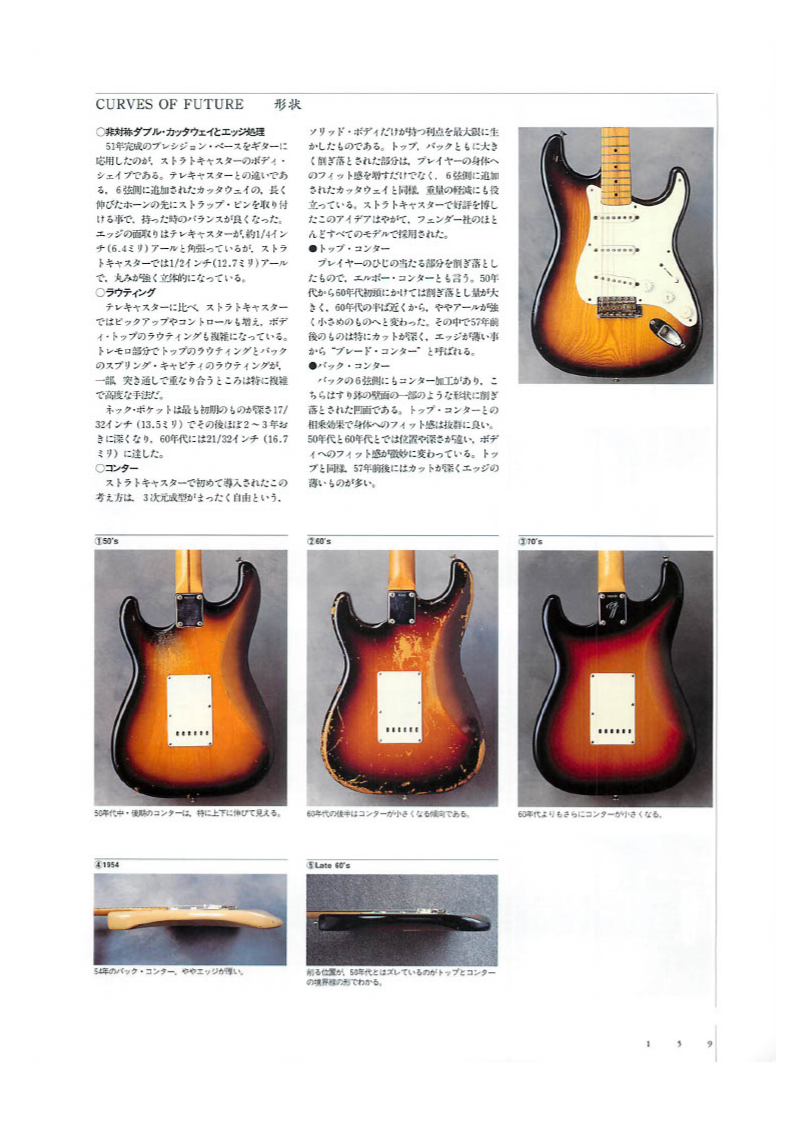
① ’50s
The contours on Stratocasters from the middle and later 1950s appear particularly elongated vertically.
② ’60s
By the latter half of the 1960s, the contours tended to become smaller.
③ ’70s
The contours became even smaller than those of the 1960s.
④ 1954
Back contour of a 1954 Stratocaster. The edge is somewhat thicker.
⑤ Late ’60s
The shape of the boundary between the top surface and the contour shows that the position of the carved area had shifted from that of the 1950s.