CUSTOM COLORS
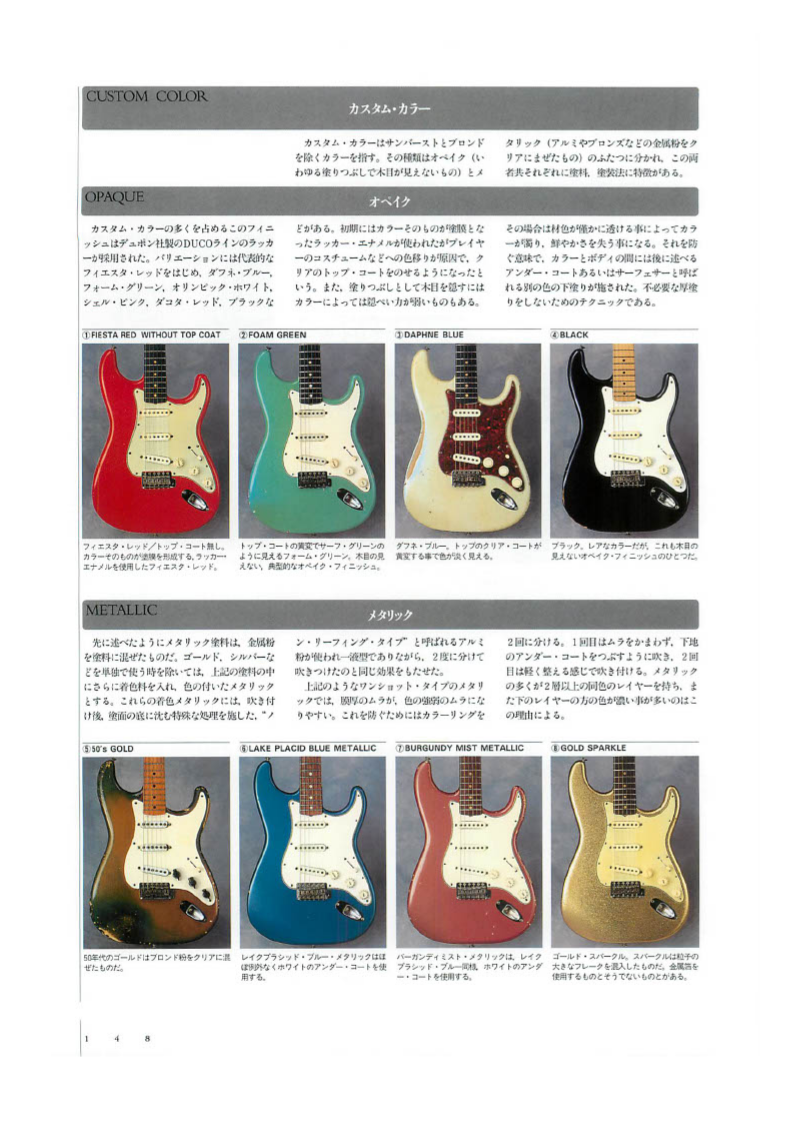
Custom colors refer to finishes other than Sunburst and Blonde. They can be divided into two basic categories: opaque finishes (solid colors that completely conceal the wood grain) and metallic finishes (colors containing metallic particles such as aluminum or bronze mixed into a clear medium). Each of these categories has its own characteristic materials and application methods.
OPAQUE FINISHES
This type of finish accounts for the majority of Fender custom colors. Lacquers from DuPont’s DUCO line was used for these finishes. Typical examples include Fiesta Red, Daphne Blue, Surf Green, Olympic White, Shell Pink, Dakota Red, and Black.
In the early period, these colors were used by themselves as lacquer enamels, with the color coat itself forming the finished surface. It is said, however, a clear top coat was later applied over the color due to the fact that the color could rub off onto a player’s stage clothing,
When a solid color is used on wood, some times colors do not have sufficient hiding power on their own to hide the grain. In such cases, the natural color of the wood can show through slightly, making the finish appear muddy, reducing the brilliance of the color. To prevent this, a separate base coat—known as an undercoat or surfacer, described later—was applied between before the color coat. This technique made it possible to achieve adequate coverage without unnecessarily building up the finish.
1) FIESTA RED WITHOUT TOP COAT
Fiesta Red finished with lacquer enamel in which the color coat itself forms the final surface, without a clear top coat.
2) SURF GREEN
A typical opaque finish in which the wood grain is completely concealed.
3) DAPHNE BLUE
Yellowing of the clear top coat causes the original color to appear softer and more subdued.
4) BLACK
Although relatively rare as a custom color, Black is another opaque finish that completely conceals the wood grain.
METALLIC FINISHES
As mentioned above, metallic paints contain metallic particles mixed into the coating material. Except when metallic colors such as Gold or Silver are used by themselves, coloring agents are added to produce colored metallic finishes. For these mettalic finishes, DuPont’s Lucite line were mainly used.
To achieve the apearance and consistency of the color, these colored metallic finishes used what is known as non-leafing aluminum powder, specially treated so that after spraying, the metallic particles settle at the bottom, instead of floating on top (leafing type), of the paint film. With this one shot mettalic finish system (instead of having separate color spray process) more consistent colors were achieved. Due to slightly less reflective nature of non-leafing aluminum powder, these colors appear to have more depth and distinctive hue, often described “classier” look.
As with opaque finishes, metallic colors were often applied over an undercoat to prevent uneven coloration. As mentioned, one-shot type of metallic finish is more consistent than two shot type mettalics. However, variations in film thickness can still result in uneven color intensity.
In order to reduce the risk, even when under coat had been applied, the mettalic layer was often applied in two stages. The first layer was sprayed rather heavily to cover the undercoat, without being overly concerned about uniformity. The second coat was then applied more lightly, this time to even out the unevenness refining the appearance.
This explains why many metallic finishes contain two or more layers of the same color, and why the lower layer is often darker or more intense than the upper layer.
UNDERCOAT
As noted at the beginning, in order to obtain a vivid and uniform color, the natural color and grain of the wood first needed to be concealed / neutralized as an even base color. Materials known as undercoats or surfacers were well suited to this purpose.
Because they have strong hiding power and require relatively little film thickness, they make it possible to produce a thinner overall finish than would be obtained simply by applying additional coats of the same color enamel.
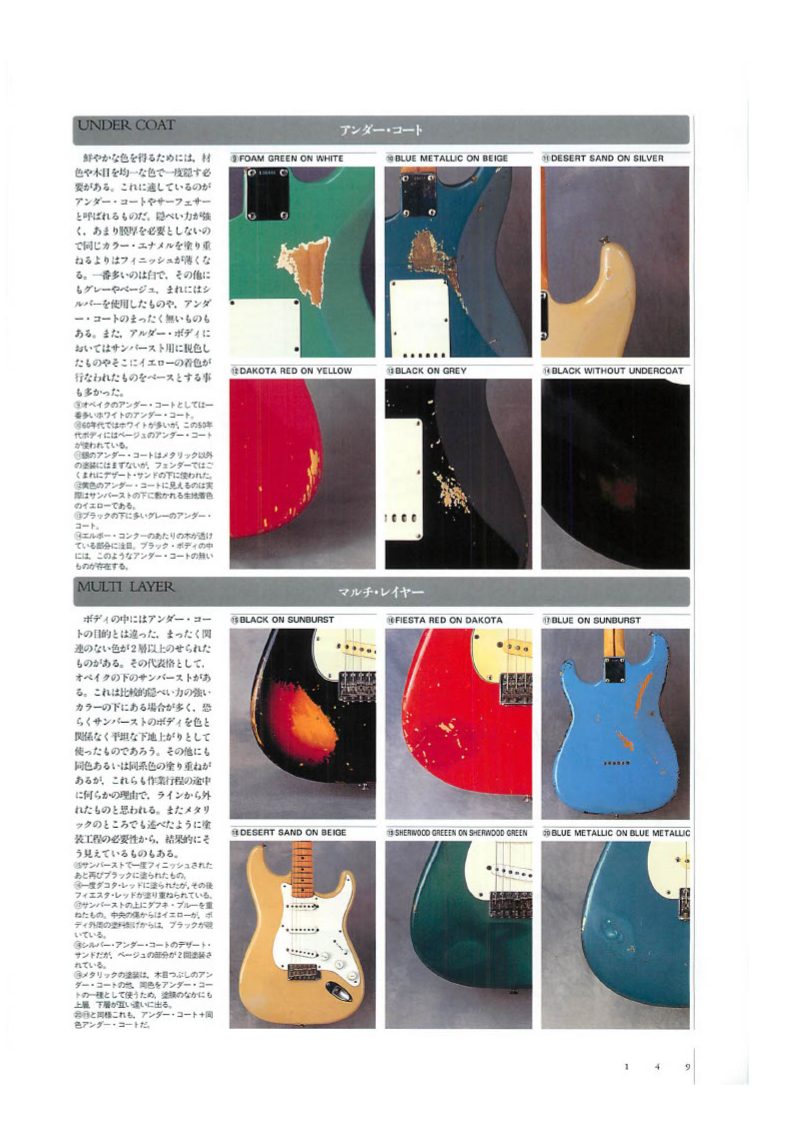
White is by far the most common undercoat, but Gray, Beige, and bleached / yellow stained base used for Sunburst finish can also be found. In rare cases, Silver was used beneath an opaque color, while some bodies received no grain hiding undercoat at all. In those cases, clear sealer only over sanded body was applied.
9) SURF GREEN ON WHITE
White, the most commonly used undercoat beneath an opaque custom color.
10) BLUE METALLIC ON BEIGE
White undercoats became common during the 1960s, but this 1950s body has a Beige undercoat beneath the Blue Metallic finish.
11) SAND BEIGE ON SILVER
Silver is almost never used as an undercoat for non-metallic wood finishes, but Fender very occasionally used it beneath Sand Beige.
12) DAKOTA RED ON YELLOW
What appears to be a Yellow undercoat is actually the yellow stain used as the base for a Sunburst finish. This indicates that the body went through the same finishing process as a Sunburst body up to coloring stage.
13) BLACK ON GRAY
A Gray undercoat, frequently found beneath Black finishes.
14) BLACK WITHOUT UNDERCOAT
Note the area around the elbow contour where the wood shows through. Some Black bodies were finished without any undercoat.
MULTI-LAYER FINISHES
Some bodies have two or more layers of completely unrelated colors that were not applied for the purpose of creating an undercoat. One of the most typical examples is Sunburst beneath an opaque color.
This is often found beneath colors with relatively strong hiding power and clearly suggests that a body already partially processed as Sunburst was subsequently used simply as a smooth, finished base for another color, regardless of the relationship between the two colors.
There are also examples in which the same color, or closely related colors, were applied in multiple layers. These bodies may have been removed from the normal production line for some reason during the finishing process and later put back in.
As described in the section on metallic finishes, however, some apparently multi-layer finishes are simply the result of the requirements of the normal painting process.
15) BLACK ON SUNBURST
A body that was first processed as Sunburst and subsequently redisignated as Black.
16) FIESTA RED ON DAKOTA RED
The body was first processed as Dakota Red, after which Fiesta Red was applied over it.
17) DAPHNE BLUE ON SUNBURST
Daphne Blue applied over a Sunburst finish. Yellow from the original Sunburst can be seen through the scratch near the center, while Black from the outer edge of the Sunburst is visible where the finish has chipped near the perimeter of the body.
18) BEIGE ON BEIGE OVER SILVER
A Sand Beige finish over a Silver undercoat, with the Beige color itself applied in two separate layers.
19) SHERWOOD GREEN ON SHERWOOD GREEN
In addition to the undercoat used to conceal the wood grain, metallic finishes may use the same metallic color itself as a form of undercoat. As a result, separate upper and lower layers of the same color can sometimes be seen.
20) BLUE METALLIC ON BLUE METALLIC
As with 19, this is another example of an undercoat combined with an additional layer of the same metallic color.