P160–161
THE NECK
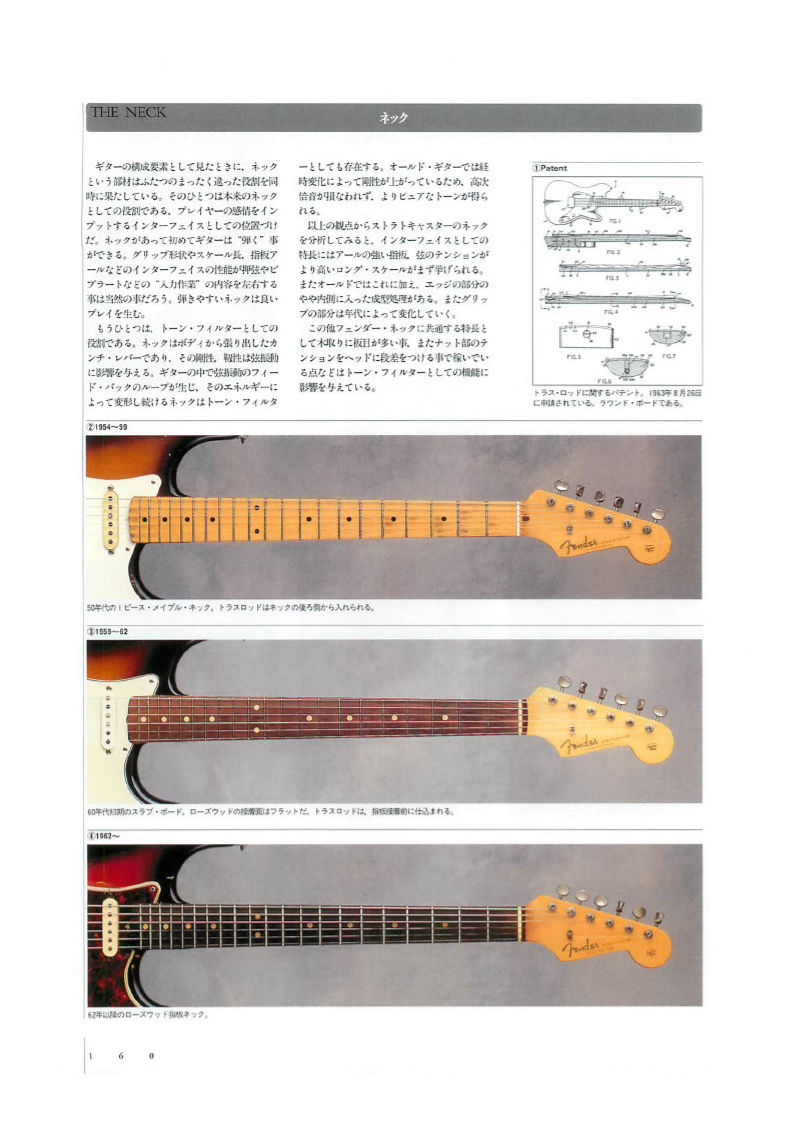
When considered as one of the structural elements of a guitar, the neck performs two entirely different functions simulteneously.
The first is its fundamental role as a neck: it serves as the interface through which the player inputs emotion into the instrument. It is the neck that makes it possible for the player to actually “play” the guitar. Naturally, the characteristics of that interface—the neck profile, scale length (affecting strings tightness, etc.), fingerboard radius, and other factors—directly affect such forms of player input such as fingering and vibrato. A neck that is more comfortable to play encourages better playing.
The second function is that of a tone filter. The neck is physically a cantilever extending from the body, and its rigidity and tenacity directly affect the vibration character of the strings. Due to the presence of string vibration feedback / interference loop within the guitar, the neck is continually subjected to vibrational energy and minute deformation caused by it. In this sense, the neck functions as a tone filter. On an old guitar, increased rigidity resulting from aging of wood helps preserve higher-order harmonics, contributing to a purer tone.
Viewed from these perspectives, several characteristics of the Stratocaster neck become apparent. As an interface, its most obvious features include the strongly (7.25 inches) radiused fingerboard and the long scale length (25.5 inches), which produces greater string tension. On vintage examples, there is also the characteristic of the fingerboard edge rolled slightly more inward. The neck profile itself changed considerably over the years.
Other features common to Fender necks—including the use of flatsawn maple and the stepped headstock, which provides the necessary string tension over the nut—also influence the neck’s function as a tone filter.
MAPLE NECK
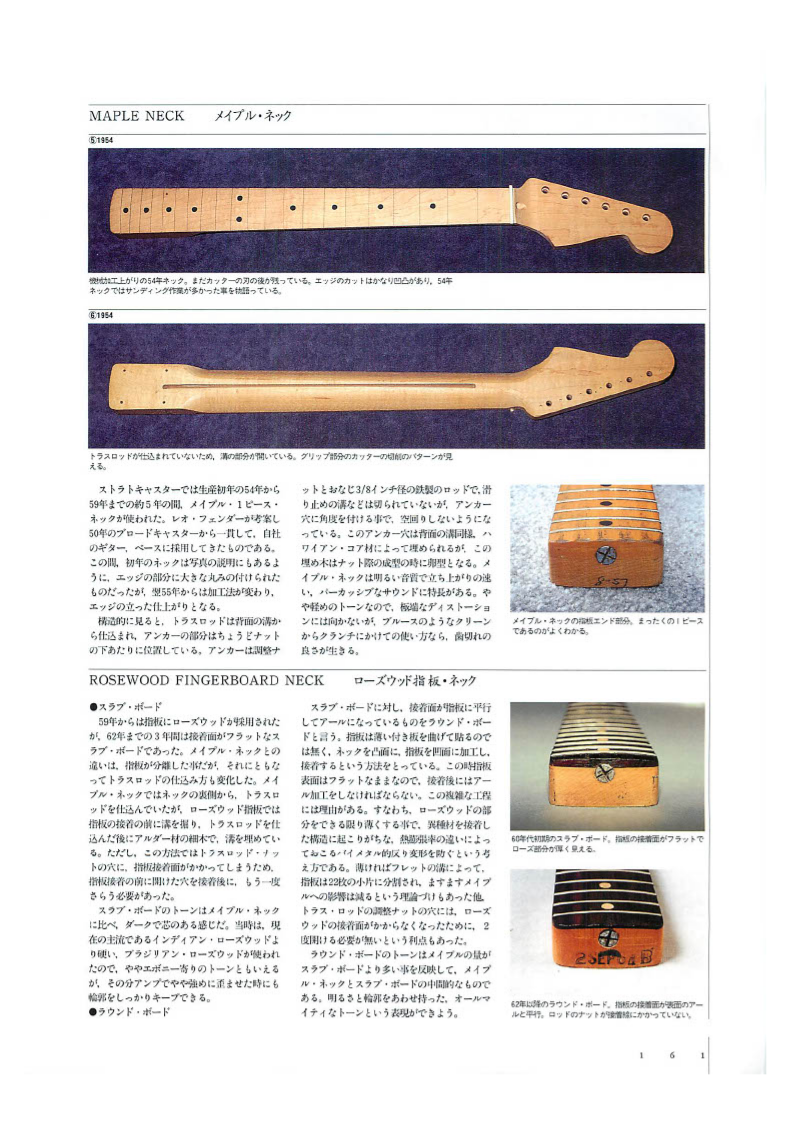
For approximately the first five years of Stratocaster production, from 1954 through 1959, a one-piece maple neck design was used. This construction had been devised by Leo Fender used consistently on Fender guitars and basses since the Broadcaster of 1950.
As described in the accompanying photographs, the necks from the first year had heavily rounded edges. Beginning in 1955, however, a change in the machining process resulted in a more sharply defined edge.
Structurally, the truss rod was installed through a channel routed into the back of the neck, with its anchor positioned approximately under the nut. The anchor was a 3/8-inch-diameter steel rod, the same diameter as the adjustment nut at the end of the neck. Although it had no grooves or other anti-rotation features, the anchor stayed secured. The placement and set angle of anchor hole was specially arranged to make this possible.
Same as the channel at the back of the neck, the anchor hole was plugged with Hawaiian koa wood. During final shaping around the nut, this plug took on its characteristic oval / egg / teardrop shape.
The maple neck is characterized by a bright tone with a fast attack and a percussive quality. Its tonal character is somewhat lighter and is therefore less suited to extreme distortion unless complex arrangement is done, but in applications ranging from clean sounds to crunch, as in blues, its crisp articulation comes into its own.
ROSEWOOD FINGERBOARD NECK
SLAB BOARD
Rosewood was adopted for the fingerboard in 1959, and for the first three years, through 1962, Fender used the slab-board construction, in which the mating / glueing surface between the fingerboard and neck was flat.
The major structural difference from the one-piece maple neck was, of course, the addition of a separate fingerboard. This also required a significant change in the method used to install the truss rod.
On maple neck, the truss rod was installed from the back. With the rosewood fingerboard construction, however, a channel was routed from the top of the neck. After the truss rod was installed in the channel, it was filled with a narrow strip of alder. When the glue cured, the execess was trimmed and fingerboard was glued on.
With this method, however, the glued joint of the fingerboard intersected the opening for the truss-rod adjustment nut at the neck end. Consequently, a hole drilled before the fingerboard installation had to be cleared out once again afterwards.
The slab board has a darker, more solid tonal character than one-piece maple neck. At the time, Fender used Brazilian rosewood, which is harder than Indian rosewood commonly used today. Its tonal character could therefore be described as somewhat closer to ebony. It retains clear definition even when the amplifier is driven into relatively higher level of distortion.
ROUND BOARD
In contrast to the slab board, the round board has a curved mating / glueing surface that follows the radius of the fingerboard.
This was not a matter of simply bending and gluing a thin rosewood veneer into place. If veneer was to be bent and glued on convex surface, at 7.25” radius, as in this case, it is highly likely that bent veneer would crack on convex / exposed surface. Instead, Leo Fender decided to take much more reliable, although significantly more complex, method. It was to machine the surface of maple part to convex, less thickness of fingerboard, then machine mating rosewood surface to concave, at same radius. At this stage, the upper surface of the fingerboard was still flat, causing fingerboard to be radioused after gluing. This process, at the end, left a rosewood cap (fingerboard) curved from both top and bottom on top of maple base.
There were reasons for this complicated process. First thoery was that, by keeping the rosewood section as thin as possible, Fender sought to minimize the bimetal-like warping that can occur in a laminated structure when two different materials expand and contract at different rates with changes in temperature.
The second theory was that, with a sufficiently thin fingerboard, the process of cutting fret slots effectively divided the rosewood into 22 small sections, further reducing its influence to the maple part.
The round-board construction was intended to provide greater dimensional stability, although this came at the cost of additional manufacturing steps. But it is interesting to see there was one more benefit inside this arrangement. Because the rosewood glue line no longer intersected the opening for the truss-rod adjustment nut, there was no longer any need to bore the opening a second time after the fingerboard had been glued.
Reflecting the greater proportion of maple compared with the slab-board construction, the tonal character of the round board falls somewhere between that of the one-piece maple neck and the slab board. It could be described as a versatile tone combining brightness with clear definition.
CAPTIONS
1)
Patent relating to the truss rod, filed on August 26, 1963. The drawing shows a round-board neck.
2) 1954–1959
A one-piece maple neck from the 1950s. The truss rod is installed from the back of the neck.
3) 1959–1962
An early-1960s slab board. The mating surface of the rosewood fingerboard is flat. The truss rod is installed before the fingerboard is glued in place.
4) 1962–
A rosewood-fingerboard neck of the type used from 1962 onward.
5) 1954
A 1954 one-piece maple unfinished neck which was never installed on a guitar. This neck blank is taken out directly after machining and cutter marks are still visible. The edge cuts around headstock are somewhat uneven, indicating typical 1954 neck character where considerable amount of sanding was required prior to clear lacquer coating.
6) 1954
With the truss rod not yet installed, the channel remains open. The cutting pattern left by the cutter for neck profile cut can clearly be seen. Also note that 4 holes at the heels are already bored at this stage.
7)
The fingerboard end of a maple neck, clearly showing its true one-piece construction.
8)
An early-1960s slab board. The flat mating surface of the fingerboard makes the rosewood section appear comparatively thick. Note truss rod nut hole cuts through the lamination line.
9) 1962–
A round board of the type used from 1962 onward. The mating surface of the fingerboard runs parallel to the radius of its upper surface. The truss-rod adjustment nut hole does not intersect the glue line.