P162–163
SYNCHRONIZED TREMOLO
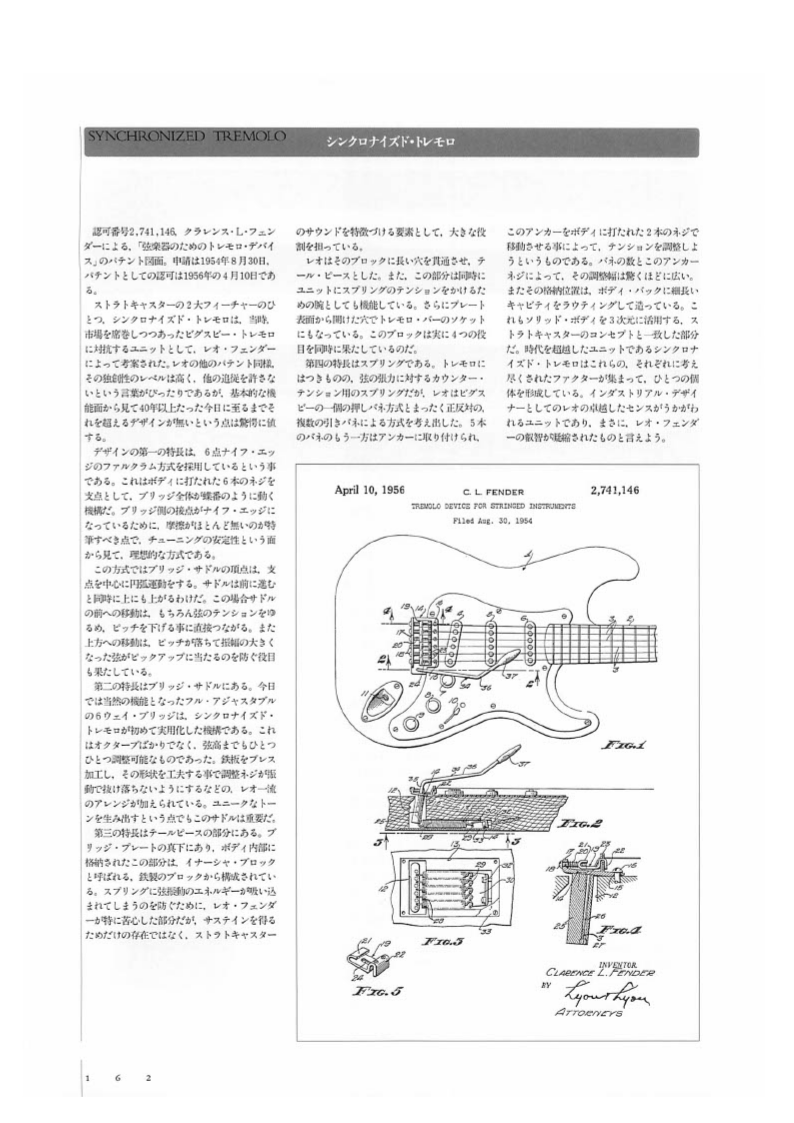
Patent No. 2,741,146, “Tremolo Device for Stringed Instruments,” by Clarence L. Fender. The patent application was filed on August 30, 1954, and the patent was granted on April 10, 1956.
One of the Stratocaster’s two major features, the Synchronized Tremolo was conceived by Leo Fender as a unit to compete with the Bigsby tremolo, which was rapidly gaining ground in the market at the time. Like Leo’s other patented inventions, it displayed an extraordinary degree of originality and was virtually without equal. Even more remarkable is the fact that, in terms of its fundamental functions, more than seventy years later no design had appeared that clearly surpassed it.
The first major feature of the design is its six-point knife-edge fulcrum system. The entire bridge pivots like a hinge on six screws driven into the body. Particularly noteworthy is the knife-edge contact at the bridge, which results in extremely low friction—an ideal arrangement from the standpoint of tuning stability.
With this system, the top of each bridge saddle travels in an arc around the pivot point. As the saddle moves forward, it also rises. The forward movement naturally reduces string tension and directly lowers the pitch. At the same time, the upward movement helps prevent the strings, whose amplitude increases as their pitch is lowered, from striking the pickups.
The second major feature is found in the bridge saddles. The fully adjustable six-saddle bridge, a feature taken for granted today, was first put into practical use with the Synchronized Tremolo. It allowed not only the intonation but also the string height of each individual string to be adjusted independently.
The saddles were formed from pressed sheet steel, and their shape incorporated the kind of ingenious detail characteristic of Leo Fender—for example, helping to prevent the adjustment screws from becoming loose and falling out due to string vibration. Looking at the parts closely, one can find that all screws are threaded into where the sheet metal is bent, making the thread actually squeezed tightly by pre-tensioned sheet metals. These saddles are also an important factor in producing the Stratocaster’s unique tone.
The third major feature is the tailpiece section. Located directly beneath the bridge plate and concealed inside the body, it consists of a steel block known as the inertia block. Leo Fender devoted particular attention to this component in order to prevent the energy of the vibrating strings from being absorbed by the springs. Its function, however, extends beyond simply providing sustain: it plays a major role in defining the characteristic sound of the Stratocaster.
Long holes are drilled through this block, allowing it to serve as the tailpiece through which the strings are anchored from the back. At the same time, the block acts as a lever arm through which spring tension is applied to the tremolo unit. A hole drilled from the top of the bridge plate also allows it to serve as the socket for the tremolo arm. In other words, this single block performs multiple functions simultaneously.
The fourth major feature is the spring system. A tremolo naturally requires springs to provide counter-tension against the pull of the strings, but Leo devised a system using multiple extension springs—the exact opposite of Bigsby’s single compression-spring arrangement.
The other ends of the five springs are attached to an anchor, whose position can be adjusted by means of two screws driven into the body. The combination of the number of springs and the adjustment provided by these anchor screws gives the system an extraordinarily wide range of tension adjustment.
The springs themselves are housed in a long, narrow cavity routed into the back of the body. This, too, is entirely consistent with the Stratocaster concept of making three-dimensional use of the solid body.
The timeless Synchronized Tremolo brings together all of these individually considered elements into a single integrated mechanism. It is a unit that reveals Leo Fender’s exceptional sense as an industrial designer—a true concentration of his ingenuity and engineering wisdom.
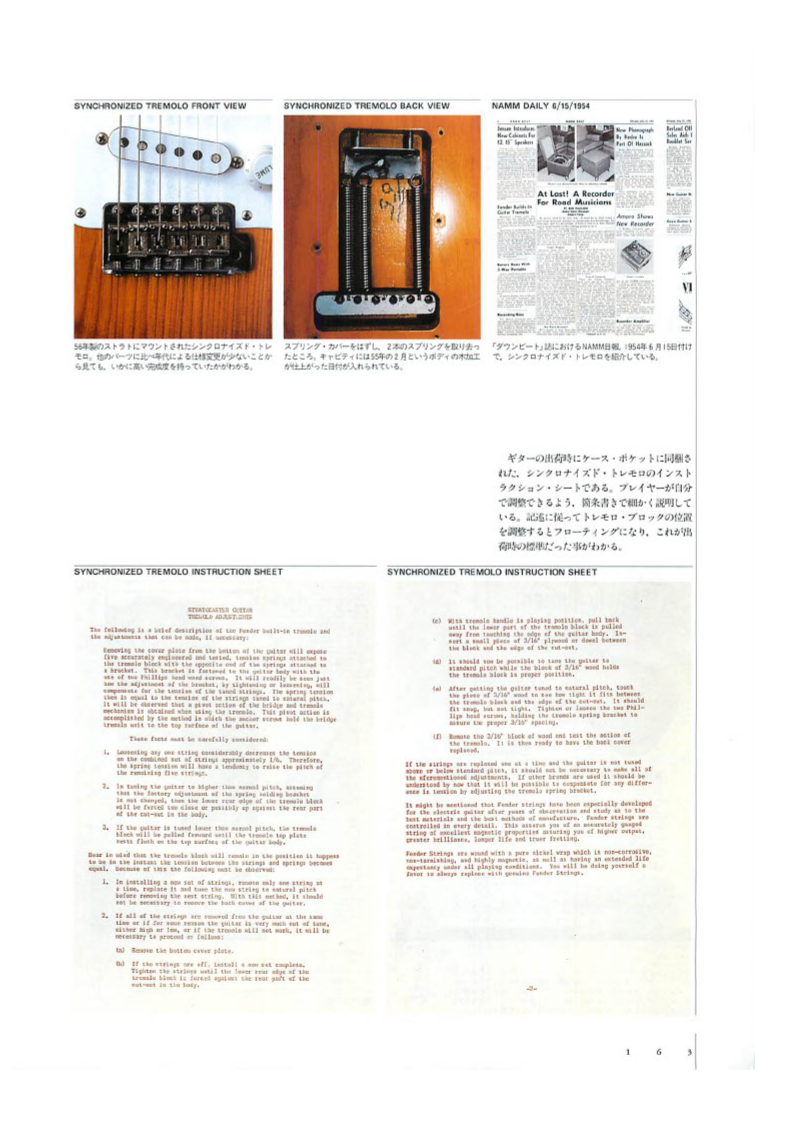
SYNCHRONIZED TREMOLO — FRONT VIEW
The Synchronized Tremolo mounted on a 1956 Stratocaster. Compared with many other components, it underwent remarkably few specification changes over the years, testimony to how thoroughly developed the original design already was.
SYNCHRONIZED TREMOLO — BACK VIEW
With the spring cover removed and two of the springs taken out. The cavity bears a February 1955 date marking, indicating when the woodworking of the body was completed.
NAMM DAILY — 6/15/1954
A NAMM daily report published in Town Beat, dated June 15, 1954, introducing the Synchronized Tremolo.
SYNCHRONIZED TREMOLO INSTRUCTION SHEET
The Synchronized Tremolo instruction sheet supplied in the case pocket when the guitar was shipped. It provides detailed, step-by-step instructions so that players could make the adjustments themselves.
Following the instructions to set the position of the tremolo block results in a floating setup, indicating that this was the standard factory setting when the guitars were shipped.