P150–151
CUSTOM COLOR CHART
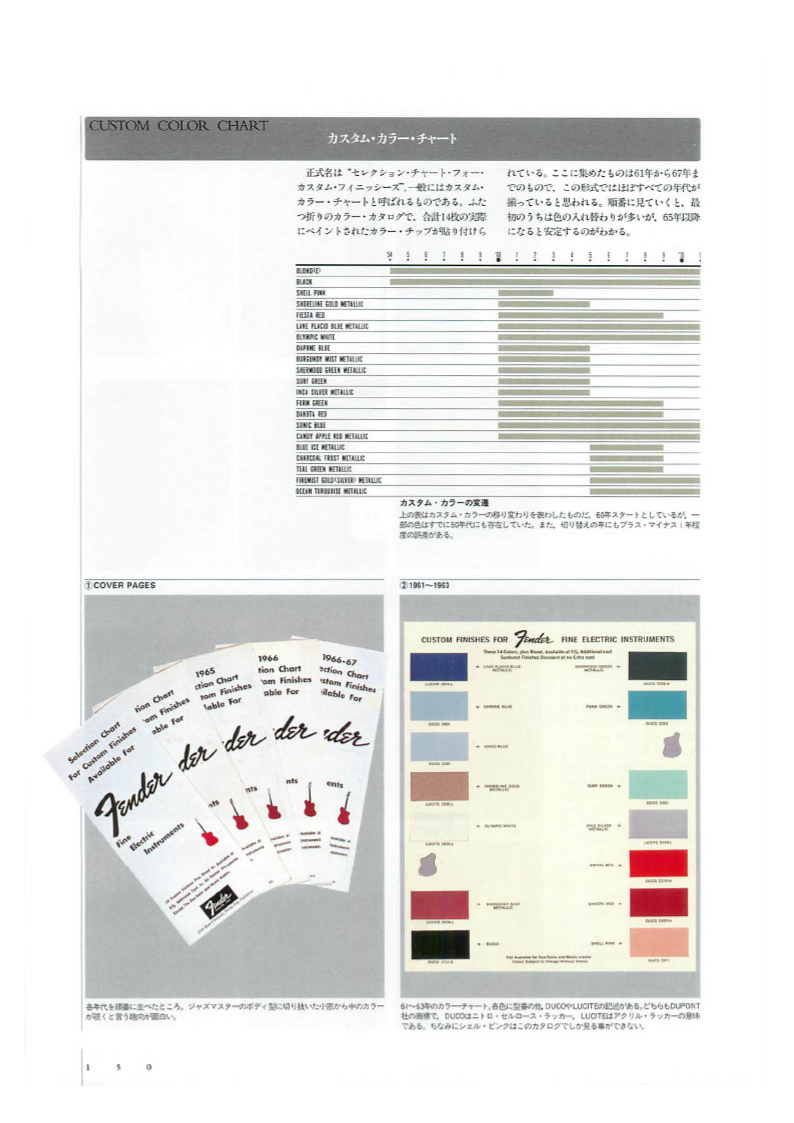
The official title was “Selection Chart for Custom Finishes,” though it is generally known as the Custom Color Chart. It was a folding color catalog containing a total of 14 actual painted color chips.
The examples shown here date from 1961 through 1967 and are believed to represent nearly every version produced in this format. Looking at them in chronological order, it can be seen that the selection of colors changed frequently at first, but became more stable from 1965 onward.
CHANGES IN CUSTOM COLORS
The chart above shows how Fender’s custom-color selection changed over the years. Although the chart begins with 1960, some of these colors had already been available in the 1950s. The years in which individual colors were introduced or discontinued should also be regarded as approximate, with a possible variation of about one year.
1)
The charts arranged in chronological order. One interesting feature is the small window cut in the shape of a Jazzmaster body, through which the actual color sample inside can be seen.
2)
The 1961–1963 Custom Color Chart. In addition to the color codes, the names DUCO and LUCITE appear beside the individual colors. Both were DuPont trademarks: DUCO referred to nitrocellulose lacquer, while LUCITE referred to acrylic lacquer. Incidentally, Shell Pink appears only in this version of the chart.
3)
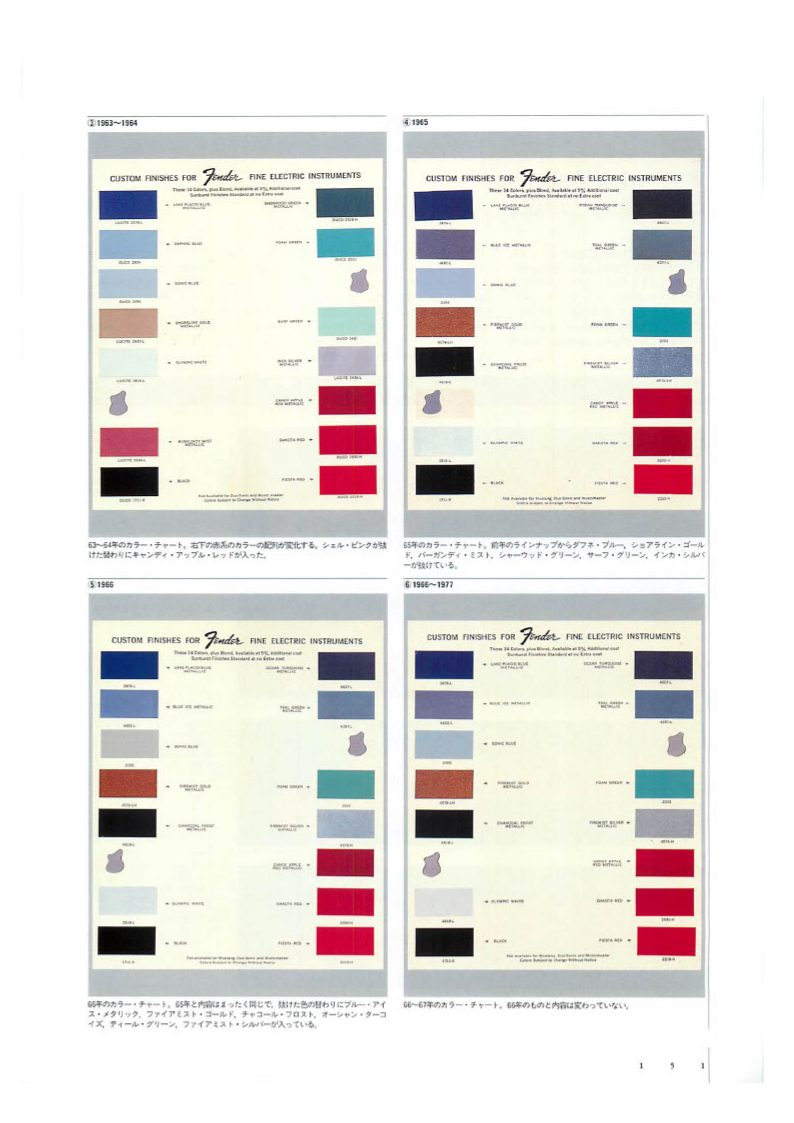
The 1963–1964 Custom Color Chart. The group of red colors at the lower right was revised. Shell Pink was dropped and replaced by Candy Apple Red.
4)
The 1965 Custom Color Chart. Daphne Blue, Shoreline Gold, Burgundy Mist, Sherwood Green, Surf Green, and Inca Silver were dropped from the previous year’s lineup.
5)
The 1966 Custom Color Chart. Basically the same contents as 1965, of which the six colors dropped from the 1964 lineup were replaced by Blue Ice Metallic, Firemist Gold, Charcoal Frost, Ocean Turquoise, Teal Green, and Firemist Silver.
6)
The 1966–1967 Custom Color Chart. The selection remained unchanged from the 1966 chart.
P154–155
PARTS & ASSEMBLY
On Stratocaster, the pickguard does more than simply protect the body from pick scratches. It also serves the important function of an assembly plate on which the pickups and controls are mounted. Its excellent design also plays a major role in defining the Stratocaster’s distinctive visual identity.
As for the plastic control knobs, one explanation is that they were used to avoid the touch noise associated with metal knobs. What is particularly interesting, however, is that their extremely low-profile design, intended to keep them from interfering with the player, was entirely original. The number and placement of the knobs and switch were also carefully considered. Despite having three pickups, the Stratocaster did not simply add more controls, but instead adopted a practical and efficient layout. Details such as the teardrop shape used for the switch tip and jack plate also show a remarkable consistency with the design language of the guitar as a whole.
1954
The earliest versions are distinguished by the materials and shapes of the knobs and other plastic parts. The potentiometers shaft of the early controls were straight, yet the knobs themselves had no set screws or other means of fastening them in place.
The very earliest version used short-skirt knobs with a relatively small flange, made of a hard, slightly translucent material. The selector switch was fitted with a somewhat smaller type of tip commonly known as a “football” knob. The shape of the pickup covers was also slightly different.
The more typical 1954 specification used white, opaque melamine knobs and pickup covers. The switch tip had also changed to the standard egg shape. This specification continued until around the middle of 1956.
② 1956–1959
The specification change introduced around mid-1956 concerned the material used for the knobs and covers. By this time, the potentiometer shafts had already been changed to the split-shaft type.
The new parts were made of nylon, which was somewhat softer and less prone to cracking. They were slightly translucent and tended to yellow with age.
③ 1959–1962
The change to a three-ply celluloid pickguard dramatically altered the appearance of the Stratocaster. Because its surface appears mint green rather than white, this type has come to be known as the “green guard.”
The green appearance results from the bluish tone of the black center layer being seen through the slightly yellowish, milky-white upper layer, causing the combination to appear green. The knobs continued to be made of nylon.
P155
① 1963–1964
The later version of the green guard. The pickguard screw that had previously been located near the left side of the neck pickup was moved slightly toward the bridge.
The control knobs remained unchanged from the earlier version.
1965–1968
The three-ply pickguard introduced in 1965 was an opaque white with no translucency. The material is rigid vinyl. Compared with the green guard, it was far less prone to yellowing with age, although aging does occur over time. Also, shrinkage is minimum on this material.
There was no change to the control knobs during this period, and nylon continued to be used.
CIRCUIT
Although the Stratocaster’s circuitry is simple, it was designed to take full advantage of its three-pickup configuration. The pickups themselves were not shielded, but a grounding plate was consistently used beneath the control section.
ASSEMBLY
A mid-1960s assembly. An aluminum grounding plate, shaped almost exactly like the pickguard, is mounted beneath it.
JACK PLATE
The teardrop-shaped jack plate is unique to the Stratocaster. Its distinctive feature is that the jack is set at an angle relative to the top surface of the body. This keeps the cable out of the player’s way while making it easy to handle.