From The Galaxy of Strats Book
By Yasuhiko Iwanade (Publisher Rittor Music)
The Galaxy of Strats book was written in Japanese in Japan in 1998. The below translation has been made by Yasuhiko Iwanade.
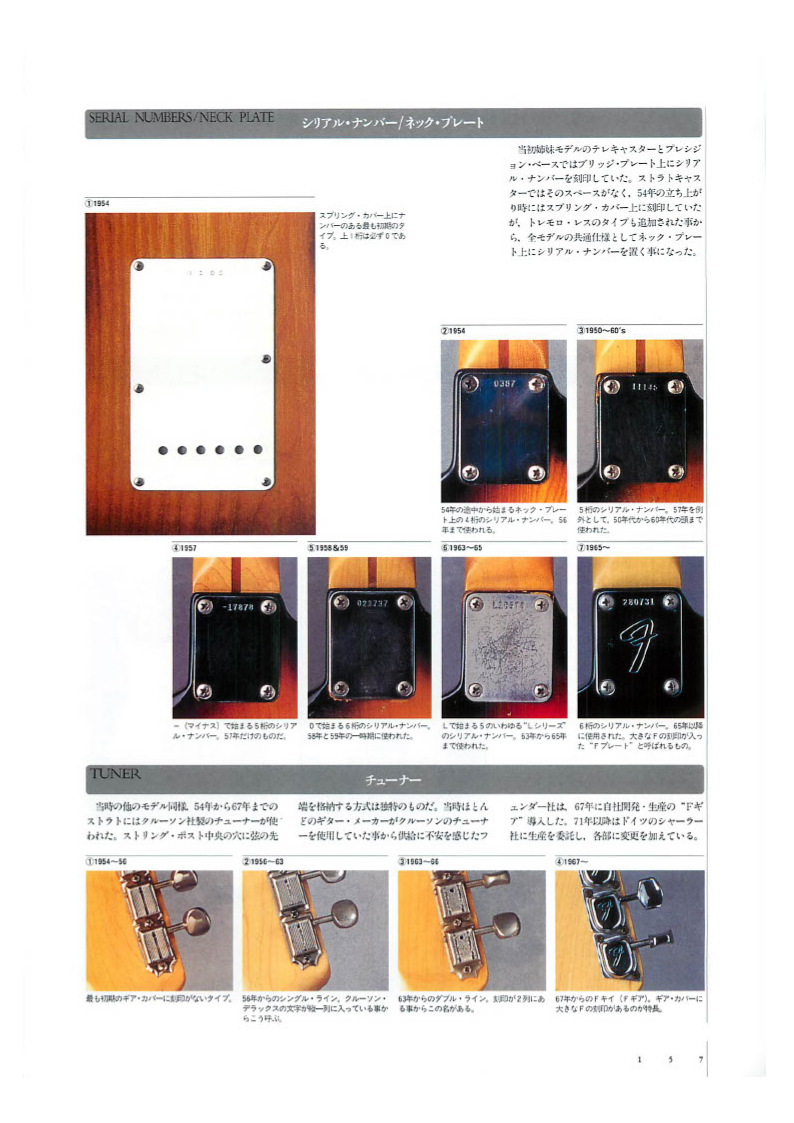
SERIAL NUMBERS / NECK PLATE
On Telecaster and Precision Bass, Stratocaster’s sister models, serial numbers were originally stamped on the bridge plate. Since there was no suitable space for this on the Stratocaster, the earliest examples produced in 1954 had the serial number stamped on the tremolo spring cover. With the subsequent addition of a non-tremolo version, however, Fender adopted the neck plate as the common location for serial numbers across all models.
① 1954
The earliest type, with the serial number stamped on the spring cover. The first digit is always 0.
② 1954
Four-digit serial numbers stamped on the neck plate, introduced during 1954. This format remained in use through 1956.
③ 1950s–’60s
Five-digit serial numbers. With the exception of 1957, this format was used from the 1950s into the early 1960s.
④ 1957
Five-digit serial numbers beginning with a minus sign (–). This type is unique to 1957.
⑤ 1958 & 1959
Six-digit serial numbers beginning with 0. These were used for a period during 1958 and 1959.
⑥ 1963–1965
Five-digit serial numbers beginning with the letter “L,” commonly known as the “L Series.” These were used from 1963 through 1965.
⑦ 1965–
Six-digit serial numbers used from 1965 onward. The neck plate, distinguished by its large stamped “F,” is commonly known as the “F plate.”
TUNER
As on Fender’s other models of the period, Stratocaster was originally fitted with Kluson tuners from 1954 through 1967. The method of securing the string was distinctive: the end of the strings was inserted into the hole in the center of the string post, then bent at right angle at the slit cut on top part of the string post to prevent slippage of strings. Another unique feature was that 6 tuners placed in line did not share one long baseplate. Instead, they were separated so that each tuner can be replaced individually. This is another example showing Leo’s attention for serviceability. Another point is that in order to make this possible where space is really tight, screws between tuners were shared, making total count of 7 instead of 12 in normal arrangement.
Since most guitar manufacturers at the time relied on Kluson tuners, with steep increase of demand for guitars at the time, consistency of supply became at most concern for Fender. To give this serious concern a solid solution, in 1967, the company introduced its own internally developed and manufactured tuner, commonly known as the “F key” or “F gear.” From 1971 onward, production was contracted to the German manufacturer Schaller, with a number of changes subsequently made to the design.
① 1954–1956
The earliest type, with no lettering stamped on the gear cover.
② 1956–1963
The “single-line” type introduced in 1956. The name comes from the words KLUSON DELUXE stamped in a single vertical line at the center of gear cover.
③ 1963–1966
The “double-line” type introduced in 1963, so called because the lettering on the gear cover is arranged in two lines.
④ 1967–
The F key (F gear) introduced in 1967. Its distinguishing feature is the large letter “F” stamped on the gear cover.