P156
PICKUP
One of the distinctive features of the Stratocaster pickup is that it is supported at two points, one at each end of the bobbin, and the way it is mounted. Interestingly, its size falls almost exactly between that of a Telecaster neck pickup and a Precision Bass pickup.
The bobbin construction, consisting of two pieces of vulcanized fiber with magnets passing through both of them, is another example of Leo Fender’s distinctive design approach, also found on other Fender models. The major difference for this model is in the mounting method. While the pickups on the other two previous models are mounted directly to the body with wood screws, the Stratocaster pickups are suspended from the pickguard.
This arrangement resulted naturally from using the pickguard as an assembly plate carrying the pickups and controls. We can see that this design significantly contributes to producibility as well as serviceability. However, one thing to note here outside of functionality, often not mentioned, is the pickup’s mass in relation to the body’s mass. Because the pickups are not mounted directly to the body, but hanging from the pickguard which is only secured by several screws on to the body, the significant mass of pickups which consists of metal (copper and magnet which is also metal) are only partially connected to body mass. As a result, this unique arrangement makes a noticeable difference in tone, as the body is an important part of the guitar’s vibration loop mechanism.
The insulation used on magnet wire was also unique to this model. Rather than oleoresinous enamel insulation wire used for the Telecaster and Precision Bass pickups, the Stratocaster used Formvar-insulated wire. This was another major factor affecting tone through its influence on interwinding capacitance.
The Stratocaster was also one of the first models in adopting individually staggered magnet heights for the strings. One of the unique features on earliest 1954 version was that the magnet for the third string was lower, but in 1955 it was raised to the same height as that of the fourth string. Early pickups were also treated with black wax to help prevent microphonic feedback and influence or moisture, as was the Telecaster bridge pickup of same era. The usage of plastic pickup covers was also ahead of other Fender models.
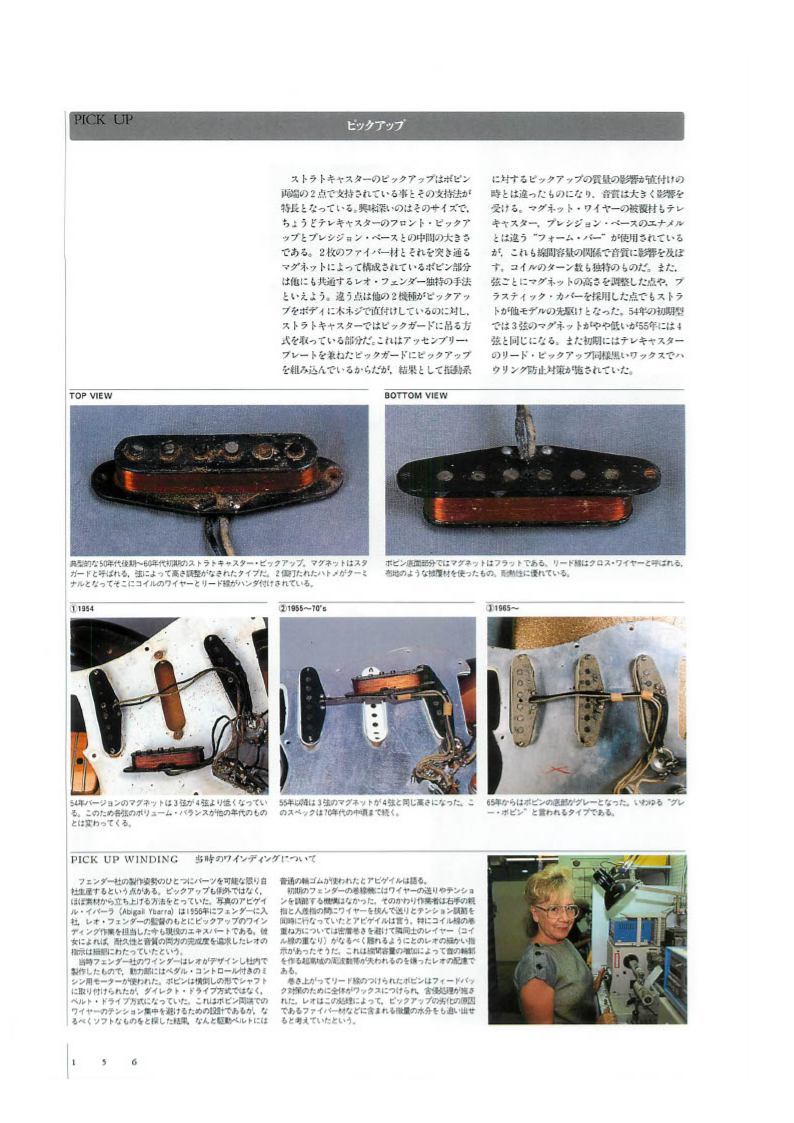
TOP VIEW
A typical Stratocaster pickup from the late 1950s to early 1960s. The magnets are of the type known as staggered poles, with their heights varied according to the individual strings. Two eyelets serve as terminals, where the coil wire and lead wires are soldered.
BOTTOM VIEW
On the bottom of the bobbin, the ends of the magnets are flush. The lead wires are the type commonly known as cloth wire, using a fabric-like insulation material with excellent heat resistance.
① 1954
On the 1954 version, the magnet for the third string is lower than that for the fourth string. As a result, the volume balance among the individual strings differs from that of pickups from later periods.
② 1955–’70s
From 1955 onward, the magnet for the third string was raised to the same height as that for the fourth string. This specification continued until the mid-1970s.
③ 1965–
Beginning in 1965, the bottom vulcanized fiber plate of the bobbin was changed to gray in color. This is the type commonly known as the “gray bobbin.”
PICKUP WINDING
One of Fender’s manufacturing principles was to produce as many components as possible in-house. Pickups were no exception, and were made virtually from the raw materials up.
Abigail Ybarra, shown in the photo, joined Fender in 1956 and worked winding pickups directly under Leo Fender’s supervision. At the time of the interview in 1997 (the actuall interview will be added to Guitar Legends section in near future) , she was still an active expert in the field. According to Ybarra, Leo’s instructions were extremely detailed, reflecting his determination to achieve the highest possible standards in both durability and sound quality.
The pickup winding machines used at Fender at the time were designed by Leo and built in-house. They were powered by sewing-machine type motors with foot-pedal speed controls. The bobbin was mounted on a spindle, but rather than directly driven on a motor shaft, the spindle was driven by a belt-drive system. This belt-drive method was specifically chosen in order to reduce excessive wire tension concentrating at the ends of the bobbin. Ybarra recalled that, in searching for the ideal driving belt soft enough for this purpose, Fender settled not on industrial type drive belt, but an ordinary rubber band.
The early Fender winding machines had no mechanism for controlling wire feed or wire tension. Instead, according to Ybarra, the operator held the wire between the thumb and index finger of the right hand, simultaneously controlling both the sideway feed and the tension.
Leo gave particularly detailed instructions concerning the way the coil wire was laid down. Rather than winding it in tightly packed layers, he wanted adjacent layers of wire to be kept as separated as possible. His concern was to minimize interwinding capacitance, which he believed would otherwise reduce the higher frequencies responsible for definition and clarity in the sound.
Once the coil had been wound and the lead wires attached, the entire bobbin was immersed in wax for impregnation as a measure against microphonic feedback. Leo also believed that this treatment would drive out even the minute amounts of moisture contained in the fiber material and other components. He wanted to make sure that the cause of deterioration of the pickup over time is eliminated beforehand.