FACTS OF STRATS — An Analysis of the Data
SERIAL NUMBERS
As mentioned in the section on parts, except for the very earliest examples, Stratocaster serial numbers were stamped on the neck plate, just as they were on Fender’s other models of the period. The numbers initially started at four digits, and the digit count grew as production progressed. However, there are some discrepancies between production timing and the dates the numbers suggest, along with some intriguing large jumps in numbering — worth a closer look. Let’s trace that progression here, using the chart as our reference.
Following the changes in order: the numbering that first appeared on the spring cover plate in 1954 moved to the neck plate within that same year, still at four digits. Then toward the end of 1954, the numbers suddenly jump by several thousand — the chart shows numbers in the 7000s, though examples in the 6000s also appear to exist. Moving from 1955 into 1956, as the 8000s near their end, the numbers inexplicably become five digits with a leading zero. During 1956, the 9000s are used up and numbers with a leading 1 begin, though occasionally guitars with numbers in this range turn out to be from 1955.
1956 continues as is, and in 1957 the numbers keep progressing, but now a minus sign is added to the front. This sign seems to begin around number 17000. Since this is a feature almost unique to 1957, it’s an easy way to spot the year — but caution is needed, since 1957 examples with numbers in the 16000s or below, without the minus sign, also exist. Come 1958, the minus sign eventually gets replaced by a 0, which would suggest a genuine six-digit number is forming — but oddly, this 0 disappears again within that same year.
From the end of the 1950s into the early 1960s, this format holds and the numbers keep climbing steadily. Production volume rises too, and once the 90000s are used up, the digit after 99999 would normally need to roll over — but here, instead of simply starting a six-digit series with a leading 1, Fender used the letter L. This is the well-known L-series serial number; one theory holds it stands for Leo’s “L,” though this isn’t confirmed. This series, presumably starting from L00001, progresses steadily and had already reached L99999 by 1965. By then management had already passed to CBS, and this time the numbering simply starts a straightforward 100000 series with a leading 1. It then reaches the 200000s in 1967, and the 300000 series begins from the end of the 1960s into the 1970s.
WEIGHT
Among a guitar’s specifications, weight matters a great deal, since it affects both playability and tone at the same time. The Stratocaster started out in 1954 with an ash body and maple neck, but amid shifting demands, the body wood changed from ash to alder in 1956, and the fingerboard was replaced with rosewood in 1959. Weight changed along with these shifts — let’s analyze what that looked like.
There are various factors to weigh when it comes to weight. Since the neck accounts for relatively little volume, it’s natural to assume the body — which makes up a much larger share of the total volume — has the greater effect on overall weight. Analyzing the chart’s numbers from that angle turns up some interesting facts.
The analysis compares the weight of ash-body guitars against alder-body guitars. Taking averages from the chart, after excluding tremolo-less examples and outliers with unusually extreme weights, ash guitars come out to roughly 3,490 grams and alder guitars to roughly 3,460 grams — remarkably close values. That said, alder-spec guitars mostly have rosewood fingerboards, which adds a little weight, and there’s also a small weight difference from variations in pickguard thickness, so a closer look shows the actual difference attributable to the body itself is somewhat larger. Even accounting for that, though, the figures are still close enough to be notable.
Digging a little deeper and looking at the individual figures reveals something even more interesting. Weight varies widely for ash-spec guitars, from about 3,100 to 3,800 grams, while alder-spec guitars fall within a much narrower band of just 3,300 to 3,600 grams. This suggests that Fender at the time was moving toward a material with more consistent, stably-suppliable variation, as a way to secure more consistency in the finished product. Incidentally, records show that Fender also used woods like basswood and mahogany on a small scale, in addition to ash and alder.
NECK
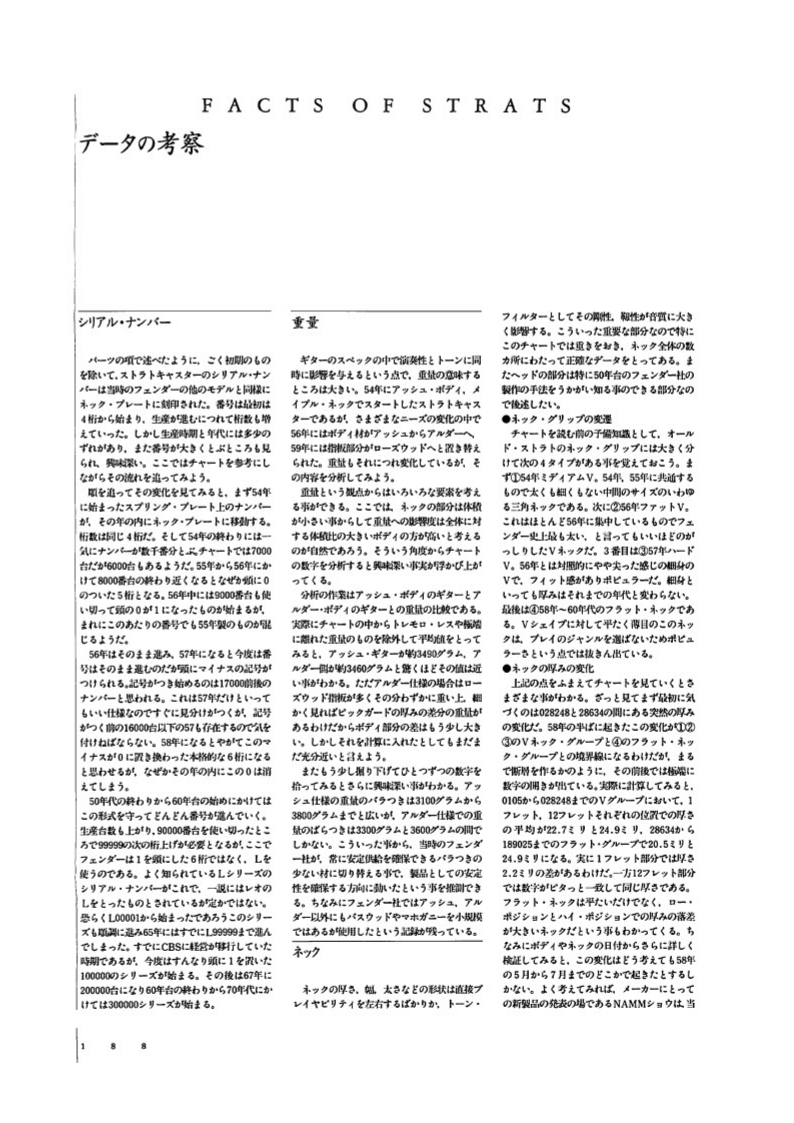
The shape of the neck — its thickness, width, girth, and so on — directly governs playability, and as a kind of tonal filter, its rigidity and resilience have a major effect on the sound as well. Because these are such important factors, this chart places particular emphasis on the neck, taking precise measurements at several points along its full length. The headstock in particular offers a valuable window into Fender’s manufacturing methods of the 1950s, so I’ll go into that in more detail below.
CHANGES IN NECK PROFILE
As background before reading the chart, it helps to know that old Stratocaster neck profiles broadly fall into four types. First is ① the 1954 Medium V — common to 1954 and 1955, this is the so-called triangular neck, a middling size that’s neither especially thick nor especially slim. Second is ② the 1956 Fat V — found almost exclusively in 1956, this is a solid, substantial V-neck that could fairly be called the thickest in Fender’s history. Third is ③ the 1957 Hard V — in contrast to 1956, this is a slightly sharper, slimmer-feeling V that sits comfortably in the hand and remains popular; “slim” here refers to feel, since its actual thickness doesn’t differ from the preceding years. Last is ④ the 1958–1960s Flat Neck. Flatter and thinner than the V shapes, this neck stands out for its popularity, since it suits any playing style.
CHANGES IN NECK THICKNESS
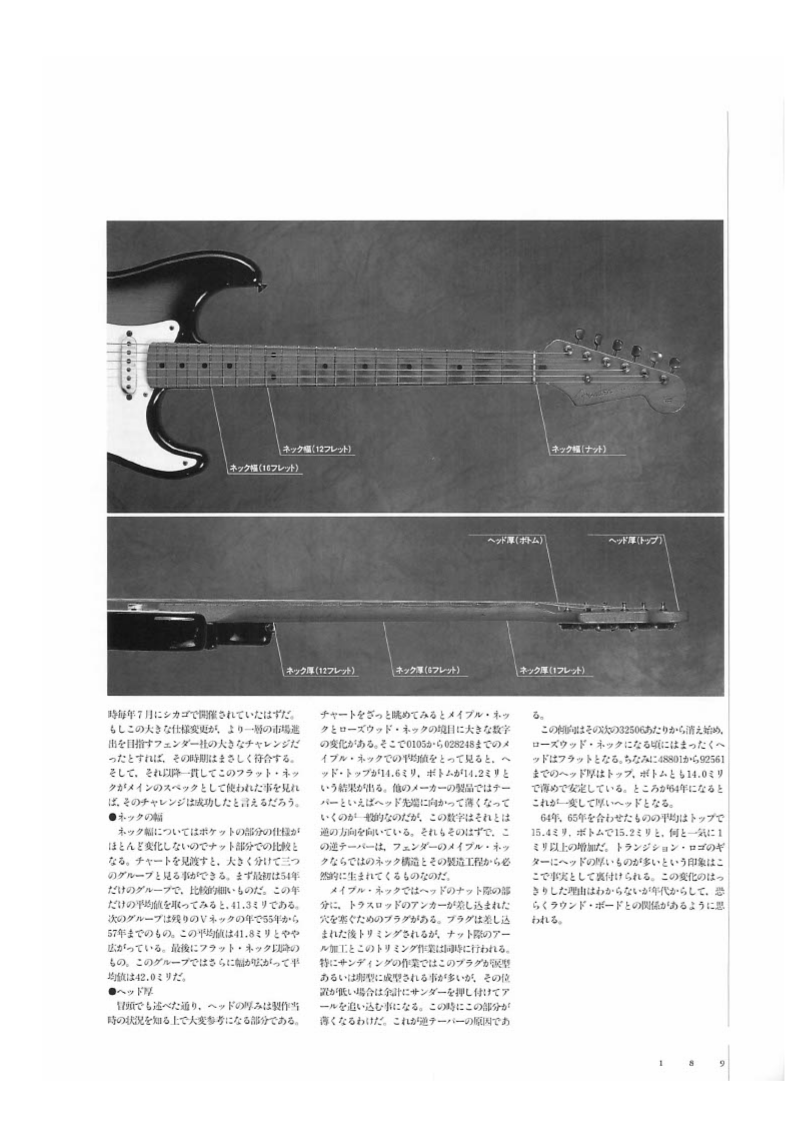
Keeping these points in mind while going through the chart reveals a number of things. The first thing that jumps out is the sudden change in thickness between 028248 and 28634. This shift, which happened in the middle of 1958, marks the boundary between the ①②③ V-neck group and the ④ flat-neck group — and the numbers on either side of it diverge so sharply it’s almost like a geological fault line. Working out the actual averages: for the V-neck group from 0105 to 028248, the average thickness at the 1st and 12th fret positions is 22.7mm and 24.9mm; for the flat-neck group from 28634 to 189025, it’s 20.5mm and 24.9mm. That’s a full 2.2mm difference at the 1st fret. At the 12th fret, on the other hand, the numbers match exactly — the same thickness. This tells us the flat neck isn’t just flatter overall; it also has a much bigger drop in thickness between the low and high positions.
Digging further into the dates on the bodies and necks, this change can really only have happened sometime between May and July of 1958. And it’s worth remembering that the NAMM Show — where manufacturers unveiled new products to the trade — was, at the time, held every July in Chicago. If this major spec change was Fender’s big push to break further into the market, the timing lines up perfectly. And given that this flat neck went on to be used consistently as the main spec from then on, it’s fair to say the gamble paid off.
NECK WIDTH
As for neck width, the neck-pocket dimensions barely change, so the comparison is made at the nut. Looking across the chart, the figures fall into roughly three groups. First, 1954 alone, which is relatively narrow — averaging 41.3mm for that year. The next group covers the remaining V-neck years, 1955 through 1957, averaging a bit wider at 41.8mm. Finally, everything from the flat neck onward, where the width widens further still, averaging 42.0mm.
HEADSTOCK THICKNESS
As mentioned at the outset, headstock thickness is an especially useful clue to the conditions under which these instruments were made.
Glancing over the chart, there’s a marked shift in the numbers right around the boundary between maple necks and rosewood necks. Averaging the maple necks from 0105 to 028248, the headstock measures 14.6mm at the top and 14.2mm at the base. On other makers’ instruments, “taper” normally means the headstock gets thinner toward the tip, but these figures point the opposite way. That’s for good reason: this reverse taper is an inevitable result of the neck structure and manufacturing process unique to Fender’s maple necks.
On a maple neck, there’s a plug near the nut end of the headstock that fills the hole where the truss-rod anchor was inserted. After the plug is set in, it’s trimmed by small radius drum sander at the same time the radius near the nut is shaped and the face of headstock leveled flat. Because the plug was inserted at shallow angle, sometimes the sander had to be pressed a bit harder in this area to work the radius down a further — which is what thins out this area. This was the cause of the reverse taper.
This tendency starts fading from around serial number 32506, and by the time necks switch to rosewood, the headstock is completely flat. For reference, from 48801 to 92561 the headstock stays thin and stable at 14.0mm at both top and base. But in ’64 this flips entirely, and the heads become thick.
Averaging ’64 and ’65 together, the top comes to 15.4mm and the base to 15.2mm — a jump of more than 1mm all at once. This bears out, as fact, the long-held impression that transition-logo guitars tend to have thicker heads. The precise reason for this change isn’t clear, but given the timing, it seems likely related to the round board.