P152–153
STUDY OF STRATS — PART 2
CLOSE-UP OF DETAILS
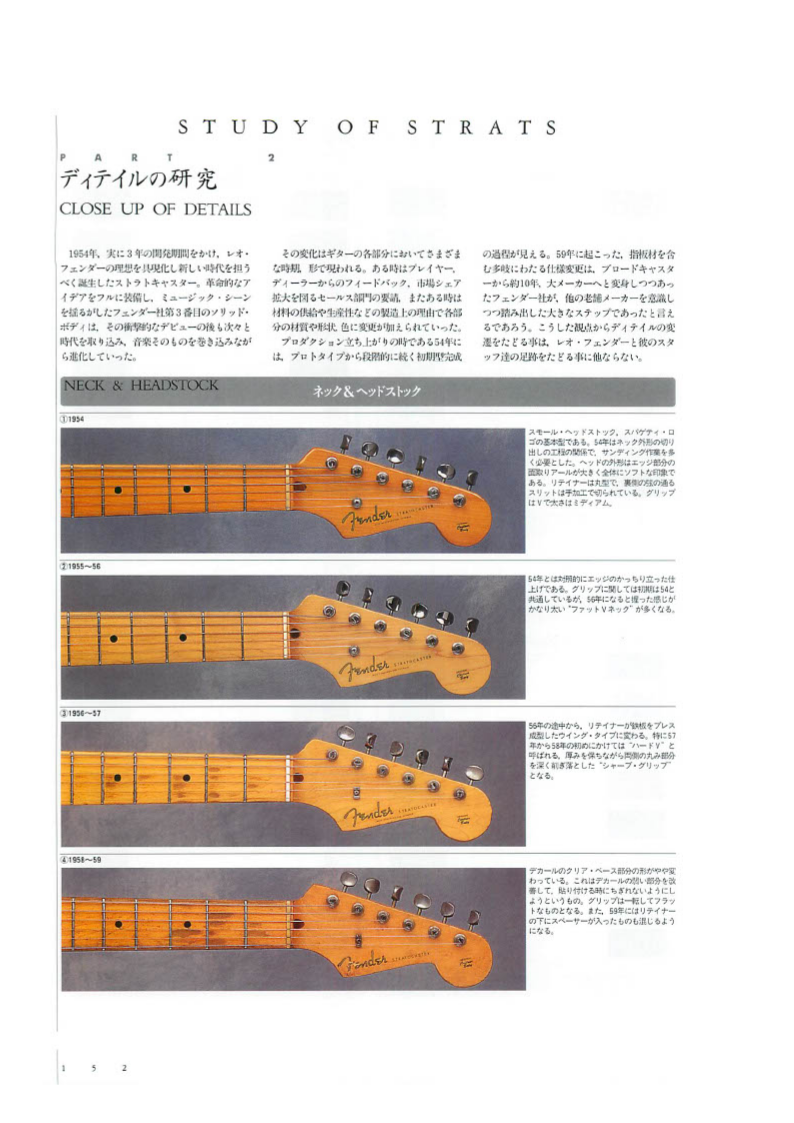
Born in 1954 after no less than three years of development, the Stratocaster embodied Leo Fender’s vision and was created to lead the way into a new era. Fully equipped with revolutionary ideas, Fender’s third solidbody guitar shook the music scene with its dramatic debut. Yet its evolution did not stop there. It continued to absorb the changes of each succeeding era, evolving along with the music itself.
Those changes appeared at different times and in different forms throughout virtually every part of the guitar. Sometimes they resulted from feedback from players and dealers, or from requests by the sales department seeking to expand Fender’s share of the market. At other times, changes in materials, shapes, and colors were made for manufacturing reasons, including material availability and production efficiency needed to live up to market demand.
The first production year, 1954, reveals the gradual process through which the early production model evolved from the prototypes into its completed form. The extensive specification changes introduced in 1959, including the change in fingerboard material, can be seen as a major step for Fender. Nearly a decade had passed since the Broadcaster, and the company was rapidly developing into a major manufacturer while becoming increasingly conscious of the long-established guitar makers around it. Viewed from this perspective, tracing the evolution of these parts is nothing less than tracing the footsteps of Leo Fender and his staff.
NECK & HEADSTOCK
1954
The basic configuration featured the small headstock and spaghetti logo. In 1954, the process used to cut the basic neck profile required a considerable amount of subsequent sanding. The outline of the headstock had more rounded edges, giving it an overall softer appearance.
The string retainer was the round type, with the groove through which the strings passed on its underside cut by hand. The neck had a medium-thickness V-shaped profile.
② 1955–1956
In contrast to the softer contours of 1954, the edges were more sharply defined. Early examples retained a neck profile similar to that of 1954, but by 1956 many had what is known as the “fat V” neck, giving a noticeably fuller feel in the hand.
③ 1956–1957
Beginning around the middle of 1956, the string retainer was changed to the wing type, formed from pressed sheet metal.
Particularly from 1957 into early 1958, the neck often had what is known as the “hard V” profile—a sharply defined grip in which the rounded areas on both sides were cut back deeply while retaining substantial overall neck thickness.
④ 1958–1959
The shape of the clear carrier (base film) surrounding the logo was modified slightly. This was intended to strengthen the more fragile areas of the water transfer decal and prevent it from tearing during application.
The neck profile, meanwhile, changed dramatically to a flatter shape. During 1959, examples also began to appear with a spacer beneath the string retainer.
P153
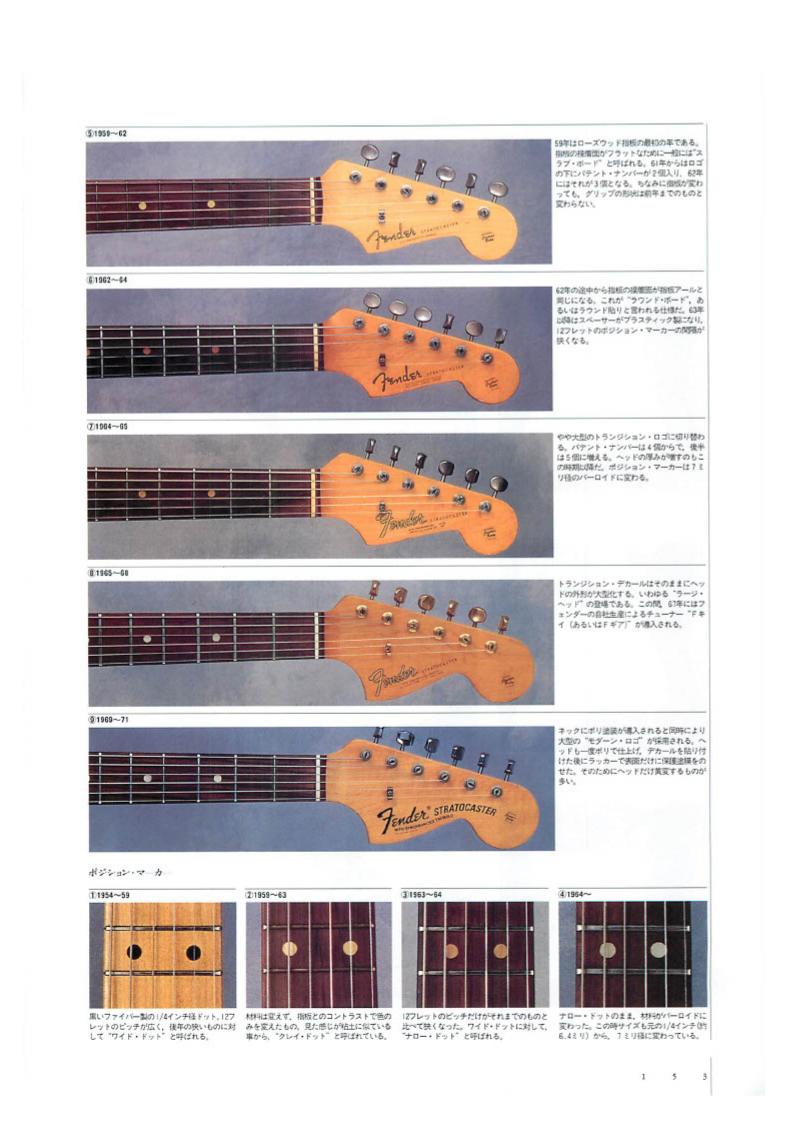
⑤ 1959–1962
1959 marked the first year of the rosewood fingerboard. Because the mating surface between the fingerboard and neck is flat, this construction is generally known as a “slab board.”
Beginning in 1961, two patent numbers appeared beneath the logo, increasing to three in 1962. Incidentally, despite the change in fingerboard construction, the neck profile itself remained essentially unchanged from the preceding year.
⑥ 1962–1964
Beginning around the middle of 1962, the mating surface of the fingerboard was changed from flat to a curved surface following the radius of the fingerboard. This construction is known as a “round board,” or round laminated fingerboard.
From 1963 onward, the spacer beneath the string retainer was made of plastic, and the spacing between the two position markers at the 12th fret became narrower.
⑦ 1964–1965
The slightly larger transition logo was introduced. It initially carried four patent numbers, increasing to five later in the period. The headstock also became thicker from around this time onward.
The position markers were changed to pearloid dots measuring 7 mm in diameter instead of previous years 1/4” (6..35mm)
⑧ 1965–1968
While retaining the transition decal, the outline of the headstock was enlarged. This marked the appearance of the so-called “large headstock.”
During this period, in 1967, Fender introduced its own internally produced tuners, commonly known as the “F key” or “F gear.”
⑨ 1969–1971
With the introduction of a polyester finish on the neck, the larger “modern logo” was adopted.
The headstock was first finished in polyester. Then after the water transfer decal was applied, protective lacquer coating was splayed on top. As a result, many examples from this era show noticeable yellowing on the headstock face only.
POSITION MARKERS
1954–1959
Black vulcanized fiber position-marker dots, 1/4 inch in diameter. The two markers at the 12th fret are spaced relatively far apart and are therefore known as “wide dots,” in contrast to the more closely spaced version used later.
② 1959–1963
The material remained fiber, as before, but the color was changed to provide contrast against the rosewood fingerboard. Because the light-colored fiber takes on an appearance resembling clay, these markers are commonly known as “clay dots,” although they were not actually made of clay.
③ 1963–1964
Only the spacing of the two markers at the 12th fret was changed, becoming narrower than before. In contrast to the earlier wide-dot arrangement, this is known as the “narrow dot” configuration.
④ 1964–
The narrow-dot spacing was retained, but the material was changed to pearloid. At the same time, the diameter increased from the original 1/4 inch (approximately 6.4 mm) to 7 mm.