From The Galaxy of Strats Book
By Yasuhiko Iwanade (Publisher Rittor Music)
The Galaxy of Strats book was written in Japanese in Japan in 1998. The below translation has been made by Yasuhiko Iwanade.

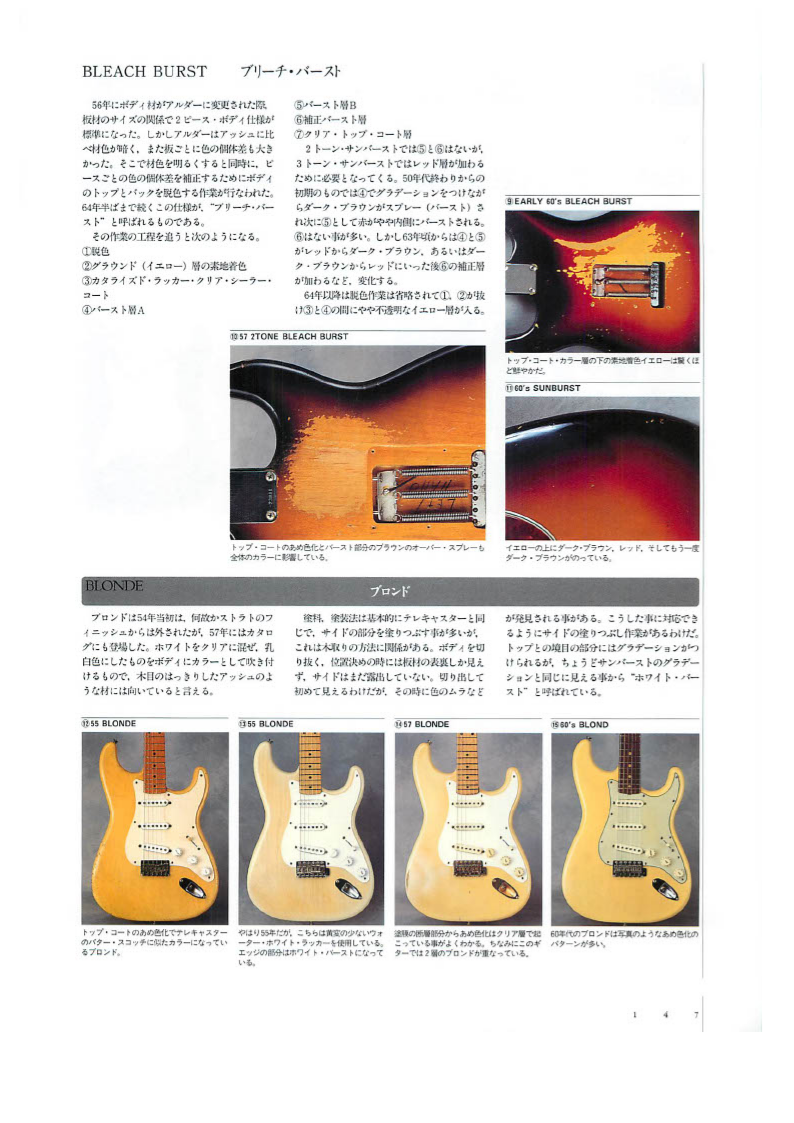
From THE GALAXY OF STRATS
P146
STUDY OF STARTS PART 1
LAYERS OF COLORS
Beginning in the 1950s, Fender was more adventurous than most other manufacturers in adopting opaque finishes and metallic colors—both unconventional choices for guitars at the time. On the Stratocaster in particular, with its three-dimensional body contours, these finishes had the effect of further emphasizing the functional beauty of its design. Here we will examine several groups of finishing techniques and variations that were distinctive to Fender.
SUNBURST
The Stratocaster was the first Fender model to feature a sunburst finish. At the time, applying a sunburst to an ash body was a fairly unusual approach. When Fender changed the body material to alder in 1956, the character of the color changed somewhat as well.
In the latter half of the 1950s, the original two-tone finish was changed to a three-tone sunburst by adding red. This became a standard Fender color that continued into the 1960s and beyond. The three-tone sunburst can be further divided into the earlier version, used through the early 1960s, in which the wood grain remained clearly visible, and the version seen from 1964 onward, in which the grain became less distinct.
This difference resulted from a change in the preparation process: the yellow was moved from direct staining of the wood to application over the sealer coat. White was added to the yellow to compensate for the somewhat darker natural color of the wood, and this had the effect of partially obscuring the grain.
By the end of the 1960s, the earlier thin synthetic-resin sealer system was replaced by a polyester undercoat as part of what Fender called the “Thick-Skin” finish. In this system, lacquer was still used for the color coats and the clear top coats.
The following photographs trace these changes over time.
1) 2 TONE SUNBURST ON ASH
A 1954 two-tone sunburst. The contrast between the natural color and pronounced grain of the ash gives this finish its distinctive character.
2) 2 TONE SUNBURST ON ALDER
A 1957 two-tone sunburst. The transition to alder began during 1956, and with the change in body wood came finishing techniques intended to compensate for the natural color of the material, including the Bleach Burst process.
3) 3 TONE SUNBURST ON ALDER
The three-tone sunburst introduced in 1958. Red was added between center yellow and dark brown area on body rim.
4) FADING BURST
A type seen only for a very brief period between examples 3) and 5). Because the red portion used a dye-based colorant that was particularly susceptible to fading, the red in the three-tone sunburst gradually faded. Examples can be seen from 1959 and 1961.
5) 3 TONE SUNBURST
Basically the same finish as 3), but the change in fingerboard gives the guitar a completely different visual impression.
6) 3 TONE SUNBURST
7) 3 TONE SUNBURST
Basically, the same as 6), but here the wood grain is somewhat less visible through the yellow area in the center.
8) 3 TONE SUNBURST
A representative early-1970s sunburst. This is the so-called “Thick-Skin” finish, in which the color coats were applied over a clear polyester undercoat, producing its distinctive appearance.
BLEACH BURST
When Fender changed the body wood to alder in 1956, two-piece body construction became standard because of the dimensions of the available lumber. Compared with ash, however, alder was naturally darker in color and also showed considerable variation in color from one piece of wood to another.
To lighten the wood and at the same time minimize color differences between the pieces, the top and back surfaces of the body were bleached. This process, which continued until around mid-1964, is what is referred to here as the “Bleach Burst.”
The finishing process can be broken down as follows:
- Bleaching / neutralizing: Bleach applied on finish sanded body, only on top and back. The color of the surfaces turns to whitish light beige. Neutralized in order to stop bleaching action then dried completely.
- Yellow layer : yellow stain applied directly to bare wood.
- Sealer coat: The body is sealed with thin synthetic resin clear sealer coat such as FULLERPLAST.
- First burst layer (very dark brown or red) sprayed.
- Second burst layer (red or very dark brown) sprayed.
- Third (corrective) burst layer applied (when necessary)
- Clear topcoats sprayed.
On two-tone sunburst, step 5 and 6 were not required, but they became necessary with the addition of the red layer for three-tone sunburst.
On three-tone sunburstr, further to enhance the graduation effect, step 5 red was sprayed from slightly farther away, aiming toward the center, instead of perpendicular to surface of body. This method made the graduation softer and more natural, while making outer rim brown more of dark chocolate color. In many cases there was no step 6.
From around 1963, however, the sequence began to vary. Steps 4 and 5 might progress from red to dark brown, or from dark brown to red, followed by the addition of the corrective burst coat in step 6.
From 1964 onward, the bleaching process was replaced by another arrangment. Steps 1 and 2 were discontinued, and opaque white / beige / yellow layer was added between step 3 and 4.
9) EARLY ’60s BLEACH BURST
The yellow stain on the wood beneath the top color coats is surprisingly vivid.
10) 1957 2 TONE BLEACH BURST
The ambering of the top coat and the brown overspray in the burst area also contribute to the overall color of the finish.
11) ’60s SUNBURST
Over the yellow are successive layers of dark brown, red, and then dark brown once again.
BLONDE
Blonde was not included among Stratocaster’s original finish options in 1954, but by 1957 it started appering in the catalog. The finish was created by mixing white pigment into clear lacquer to produce a translucent, milky-white color, which was then sprayed onto the body. It was particularly well suited to woods with a pronounced grain, such as ash.
The materials and finishing procedure were basically the same as those used on the Telecaster. The sides of the body were sprayed more opaquely making wood grain less visible. The reason for this was related to the way the body blanks were selected and cut. When positioning the body outline on a board, only the front and back surfaces of the wood could be seen; the sides were not exposed until the body had actually been cut out. Only when the body perimeter was cut, variations or discoloration (sap, knots, mineral streaks, etc.) in the wood becomes visible. Spraying the sides more opaquely provided a practical way of minimizing the visibility of minor irregularities, saving otherwise perfectly suitable wood for guitar body.
The transition between opaque sides and the top was blended gradually. Because this gradation closely resembled that of a sunburst finish, it came to be known as a “White Burst.”
CAPTIONS
12) 1955 BLONDE
A Blonde finish that has taken on a color similar to the familiar butterscotch appearance of a Telecaster as the top clear coat has ambered with age.
13) 1955 BLONDE
Also from 1955, but this example uses water-white lacquer (aging resistant type), which shows considerably less yellowing. The edges exhibit the characteristic White Burst effect.
14) 1957 BLONDE
Where the finish has been heavily worn away, the exposed layers clearly show that the ambering has occurred in the clear coat. On this particular guitar, two separate layers of Blonde can also be seen.
15) 60’s BLONDE
Blonde finishes from the 1960s often show the type of ambering seen in this example.